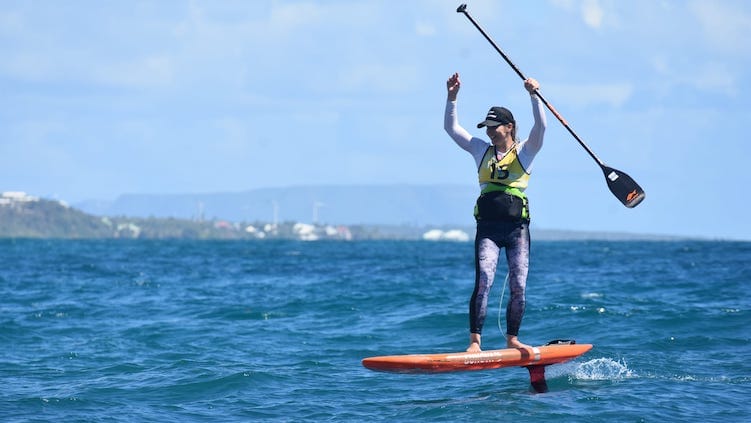
Over a year ago, a new form of SUP called SUP Foil became popular when Kai Lenny posted footage of himself hydrofoiling his Stand-Up Paddle raceboard. Since then, many riders, at all levels, have been trying it out. However, it is not always easy to get started. That’s why Greg Closier, Takuma Concept ambassador, based in San Clemente, California, wanted to give you his 6 tips on how to get started with SUP Foil.
1. Choose the right foil
When you start foiling, you have to remember to choose the right foil. If you want to SUP or surf, don’t get a kite foil, as this isn’t the best suited. Look for a tried and tested foil.
One that lifts at low speed and has good control. I advise using a small mast (40 cm), as it will be easier to maneuver and safer. The best foil I can recommend to start with is the Takuma V100.
2. Take Lessons
Ask for advice when starting out, or better yet, take lessons with an experienced instructor. As with every new activity, especially really technical ones, I recommend asking for advice from a specialist.
If you can find a really serious instructor who is eager to help you master it, you will learn much faster. Choosing the right equipment, trying for the first time, learning the basic rules and the different techniques. These are all essential elements.
SUP foiling has nothing to do with any other sport. Your background can help for sure, but it is likely quite different to what you may have tried previously, so you need to adopt a completely new approach.
3. Be safe
Be sure to get the safety gear on for your first try. And never abandon your leash! I would also recommend wearing a helmet and an impact vest, at least when you’re starting out.
4. Use a boat to tow you along
Try using a boat to tow you along at first in order to get used to the feeling of foiling. Having a boat tow you is really different to surfing, but it will help you for sure.
Riding a wave via foil is technical. The right conditions (spot/wave/crowd) must be in place. You need to concentrate not only on lifting, but also on paddling and catching waves. You don’t have much time to think as it goes very quickly and the speed can vary a good deal.
When riding behind a boat, you have to concentrate on lifting the board and handling the fly. With a good driver and a good combo of foil and board, it won’t be too difficult because you don’t have to worry about the speed.
You will be able to do it many times over. Remember that the key to mastering a sport is always practice. Repeat the proper technique as much as you can (having an instructor to help you out is always useful for getting the technique correct).
5. Find the right spot
Finding the right surf spot is essential. It has to be deep enough, uncrowded and with slow, rolling waves. The best kind is a wave that hardly breaks at all.
It is difficult and dangerous to deal with white water or breaking waves when you’re starting out. You want a rolling soft wave that passes through deep water.
6. Try again and again
Don’t give up. It takes time to get it right, so go step by step. It is very different to surfing or SUP riding. It requires a different technique and a degree of sensitivity. It is a new feeling that you’ll need to adjust to.
For more information about SUP Foil and Takuma Concept, go to takuma-concept.com
Alexandre Nogueira is the dynamic force behind the Molokabra event, a groundbreaking annual all-craft week-long downwind competition in Fortaleza, Brazil, set to take place this year from August 30 to September 8. The 2024 Molokabra promises to be extraordinary, showcasing the state of Ceará, Brazil’s premier SUP, SUP foiling and paddling downwind destination. The event’s […]
Romuald Mamadou est décidément Ze King de Ze Race. Déjà 4 fois vainqueur en stand up paddle et recordman de l’épreuve guadeloupéenne, connue pour être l’une des plus longues courses de downwind au monde, “Romu” a réitéré samedi dernier non pas sur une planche de SUP Race mais aligné sur la nouvelle discipline dont il […]
A quelques jours de la 16ème édition du Fort Boyard Challenge, que TotalSUP retransmettra en LIVE sur notre page Facebook avec les commentaires de Mathieu Astier sur les 2 courses de SUP Race, voici quelques éléments clés à retenir : Participation record en vue !! À 4 jours de l’événement, 550 sportifs sont déjà inscrits, du jamais […]
En attendant les interviews de Florent Dode, Martin Vitry et Paul Rozier, voici les résultats de Ze Race 2022 postés Samedi 29 janvier en direct sur la page Facebook de TotalSUP sur laquelle nous proposions une couverture en direct en partenariat avec la base nautique Sunset Paddling à Gosier. ZE RACE 2022 – PODIUMS ET […]
Cette semaine ont eu lieu à Morgat les tout premiers championnats de SUP FOIL DOWNWIND en France. Une épreuve à l’initiative de la commission de SUP Race au sein de la Fédération Française de Surf et organisée par un collectif autour d’Amaury Dormet et de Greg Closier au cours de l’Xtrem Gliss Festival. Félicitations à […]
Pour démarrer l’année sur les chapeaux de roue, on retrouve notre “Mr TotalFOIL”, Grégory Closier qui a profité de ses vacances de Noël pour nous faire un belle interview de son ami, le taulier du SUP race français Titouan Puyo sur sa pratique du foil et sa découverte récente du wing foil, option downwind. Il […]
Longtemps pionner du SUP race en tant qu’athlète mais aussi en tant que concepteur, Grégory Closier a pris le virage du foil dès 2017 pour désormais ne se consacrer plus qu’à ça. Un temps ambassadeur de la marque Takuma, fondateur de la marque 52FoilCo, coach spécialisé sur le tout premier foil camp de France, Greg […]
Juste après les championnats de France de SUP Race 2020 à Annecy, Clément Colmas s’offrait 2 downwinds d’affilée sur un run qui devient de plus en plus populaire parmi les adeptes du foil. Accompagné de Richard Boudia, le responsable commercial France de Takuma, et des frères Thomas et Nicolas Goyard, le cagou était bluffé par […]
La marque française Takuma spécialiste des planches de foil se développe. Présente chez plus de 100 revendeurs dans le monde, elle propose maintenant en complément son e-shop. Un an après le lancement de son Efoil, elle élargit sa gamme en proposant des 3 planches de foil à assistance électrique mais aussi, une wing et tout […]