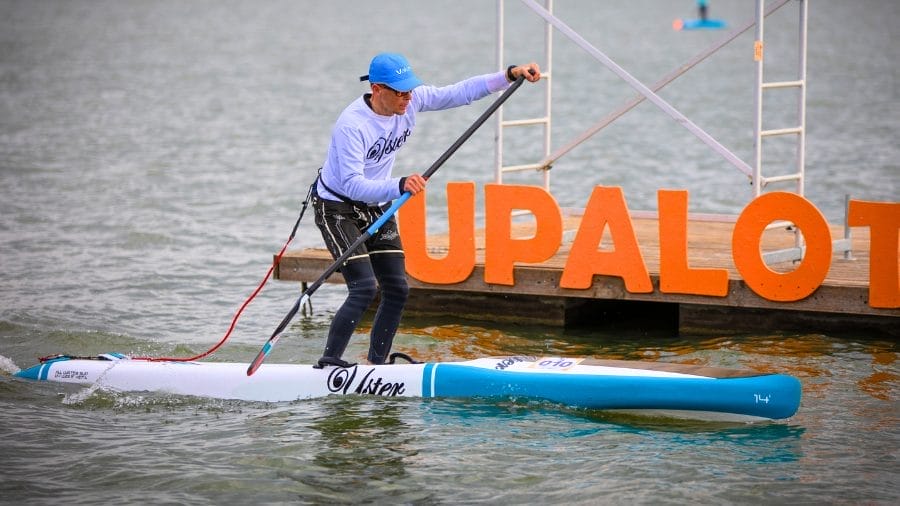
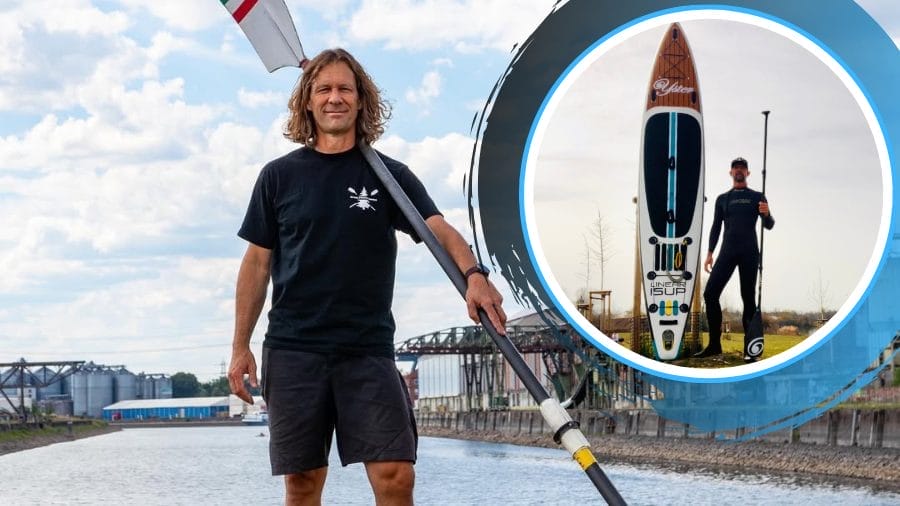
With SUP riders embracing a more conscious approach to the sport and in search of personalized experiences, enhanced performance and yes – killer designs! – custom boards are on the rise. To explore this subject further TotalSUP had a unique opportunity to catch up with Australian-born and now Sweden-based, Martin Hunter, Swedish SUP Sprint Champion and two-time Olympian and multiple World Championship medalist in canoeing, and Per Vallbo, engineer, founder and CEO of Yster SUP, a Swedish premium SUP brand that is now moving into SUP racing market. They have recently collaborated on developing a new design of a SUP racing board – Here’s the full story.
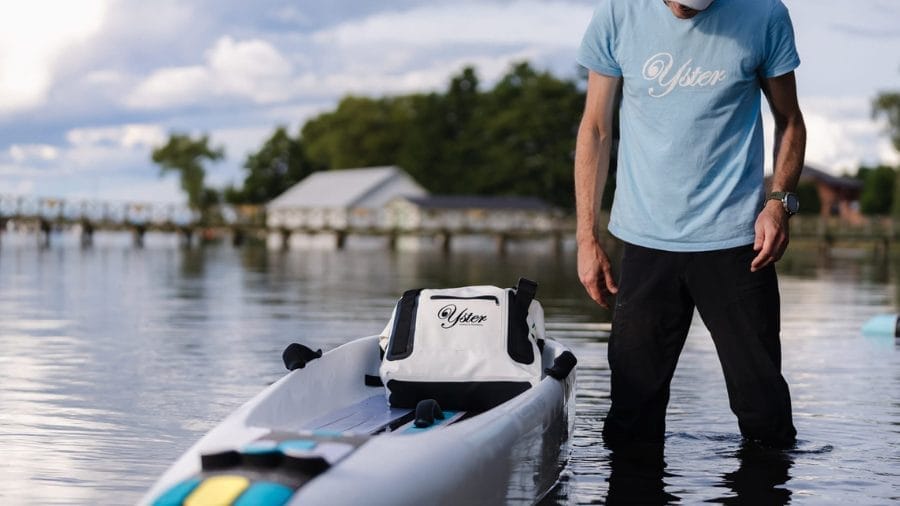
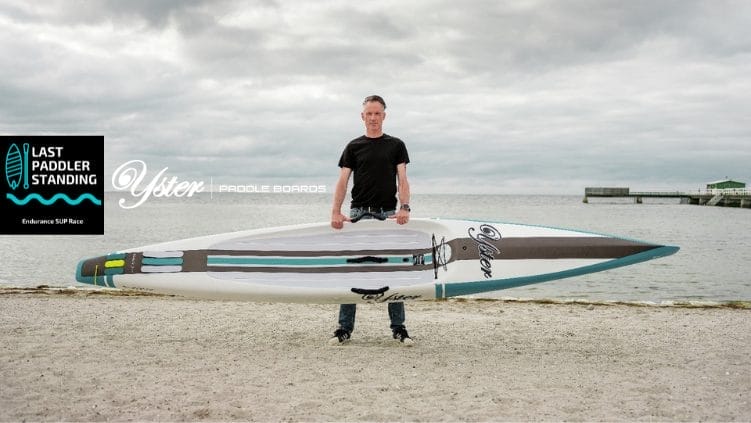
Advanced 3D modelling, iterative prototyping and extensive testing have materialized in a completely new core concept of the Yster Naked Carbon series of boards (14’x 21.5”, 14’x 24” and 14’x 26”) designed to help riders find sweet spots in their paddling technique.
Hi Martin, congratulations on the launch of the new Yster SUP Naked Carbon board concept! From Multi Olympian, World Champ to Swedish SUP Champion, Coach and innovator… What’s the story behind that transition?
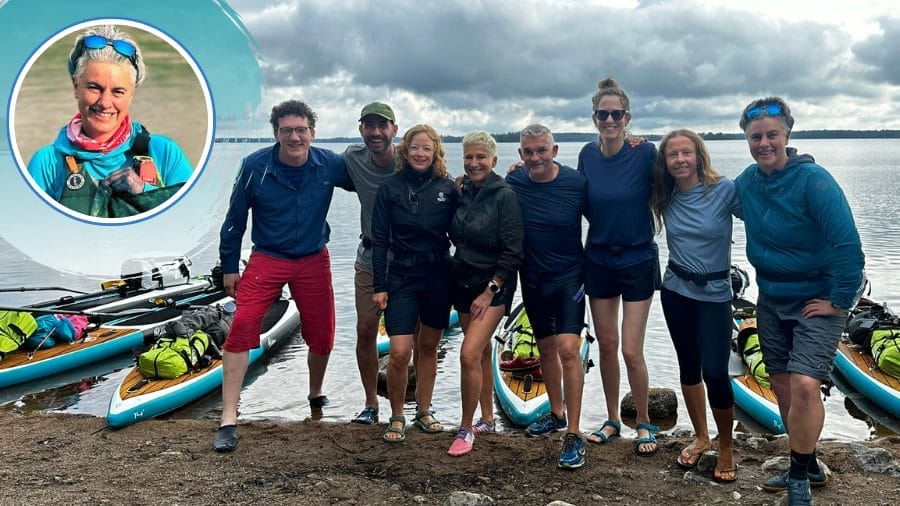
I started paddling kayaks at twelve years old in Albury, a town located on the biggest river in Australia. It was natural to spend a lot of time at the water, as it was almost always hot… I then progressed from long distance racing to sprint racing and did my first World Championships at seventeen. I made my first Olympic team at twenty-three, racing in the kayak single 500 meter in Seoul, coming 7th. The following year I became the first ever Australian to win a World Championship in Sprint Canoeing. My international elite career spanned ten years, with a total of three World Championship medal, and two Olympic Games.
Image courtesy of Martin Hunter
After retiring from racing I took up coaching, have been head coach in Sweden, Finland, Denmark, Ireland and worked with athletes from other countries such as South Africa and Switzerland. In London I had three athletes competing from three different countries! I have been fortunate to be the Head Coach at four Olympic Games.
I took up SUP paddling a few years ago, when we were on a family vacation to Florida. Since there I have kept on paddling! I guess I liked the change from kayak, a little more relaxed, but still good training. But then the competition instinct couldn’t resist the idea of racing and when they brought in the SuperSprint (100-200 meter straight line) I knew I had something I would like…
I train a lot, often I do the same sessions as those I prescribe to my athletes. I am still strong and love going fast! The principles of training for SUP are the same principles as any other sport and I really like to work with training programmes and sports performance.
Could you tell us more about your collaboration with Yster SUP?
I have had several custom-made boards, made by myself and other manufacturers. I contacted Yster SUP as I really like the design and quality of their boards and asked if they could do a custom board. As they had started working on racing boards already, the team behind the brand thought this would be a good idea.
Why a custom-made board? What are the benefits in terms of performance?
I haven’t found a standard board that I really like.There is so much “hearsay” that has come into the sport from surfing for example the volume of boards and what suits a particular weight paddler (“rider” in surf talk?)
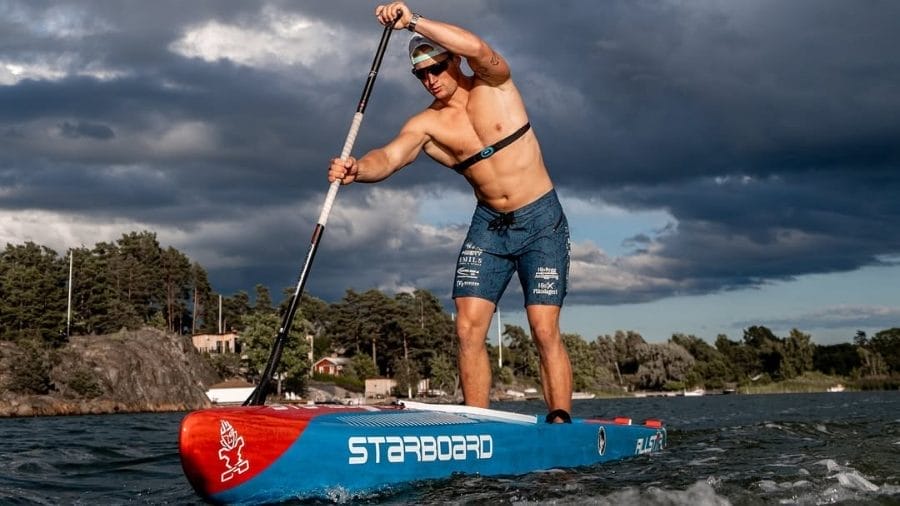
From kayaking I have very good balance, thus I can paddle on a much skinnier board and a skinnier board is also better for technique and more efficient. Having studied kayaking technique and biomechanics I have an understanding of how the body works, thus the width of where you put the paddling in is important.
I try to glide the board between strokes, to get good boat “run” (or distance per stroke), therefore I don’t like bob up and down like a lot of people suggest. Bobbing up and down is negative to the forward movement. In kayak we used technology form Catapult Minimax, which had GPS, accelerometers, gyroscopes, heart rate and even G meter inbuilt, so analysis of technique was in extreme detail.
Many of the new “skinny” boards are quite wide where you put the paddle in, and this is something we worked with to reduce on the new Yster SUP boards. Also, because it is a skinny board, it needed to be a so called “dugout” and with the dugout style the depth and width needed to be designed to suit my weight so that water drained out not in and a width for the feet position.
I also wanted a board that would track straight, that turning wasn’t a priority.So having a platform at the aft of the board to make turning easier was also not a priority. I am no expert in hydrodynamics, thus I had suggestions on what I wanted out of a biomechanical perspective and on how I wanted the board to glide in the water, go straight, don’t bob (pitch), and then Per and Yster designed the board around these parameters.
The hull design of every manufacturer seems to be different and having tried many different designs it is really hard to say which is best. Yster has a concept on the hull design that provides phenomenal straight-line tracking so we used that as the base. This means that it is possible to paddle much further on one side without the need to change sides (100 meter sprint not a problem!) and small steering corrections can even be made by leaning the board.
Many manufacturers make fancy statements about what their boards do, how they handle, the speed etc. but none as I have seen have documented this from tank testing, so most of the design feedback given is just from the feeling a particular paddler gains from the board.
There are many factors to consider in designing a board, for example if I am 90 kilos, are very strong, have a low stroke rate and good balance, compared to someone that is 70 kilos, not so strong, with poor balance and needs a high stroke rate will probably not be suited to the same board.
The deck design was fully up to Per and there was no need for excess volume. As this board is a distinct flat-water board there is no need to account for wave motion in the board design. The volume distribution has been optimized for my weight and paddling technique. For being a skinny board, it is quite stable and even at speed when it comes up to speed and rides higher in the water balance remains the same. Acceleration of the board is excellent and is particularly noticeable when doing shorter high intensity intervals with short rest periods, one comes up to speed much quicker. The glide on the board is also excellent, particular by the lack of deceleration between strokes, which on other boards has been quite noticeable, as I have relatively low stroke rate.
Now when ICF had decided on a minimum weight for race boards (9.5kgs) we can start working on construction methods where we can use weighing of the boards to trim them correctly for optimal performance! The new minimum weight also affects the materials used on boards and in boards. Hollow board or solid board (with a foam core like surf boards) is also a common discussion topic. But getting the board down to 9.5kgs is possible with a solid core and stiffness isn’t a problem with the techniques available for laminating carbon and epoxy.
What do you think the future holds for the sport of stand-up paddleboarding?
It’s hard to say. When it comes to ICF, they have had many years’ experience with rules and regulations for the sport of canoeing and how to enforce and manage these rules. So standardizing what is and is not allowed will simplify the sport and in the end what it will reduce the cost to participate. If we think about the improvement in performance of athletes and participants, I think this will come from making use of knowledge gained in sport science and coaching of elite level athletes from other sports. And then using this to plan training, having block training/macro, meso, and micro-periodization of training and understanding the actual amount and type of training needed for the sport.
More quality research in the sport will be valuable, for example search in PubMed for “Stand Up Paddle” produces only 23 articles, whereas if you choose “kayak” there are over 30000 research papers. If SUP ever get in the Olympics, then I can see a huge step, with Olympic Committees getting behind the sport and adding to the knowledge pool in the sport.
Per, congratulations on the launch! Could you tell us more about the process of designing the new Naked Carbon range?
Per Vallbo: The challenge was to make the standing area as wide as possible whilst making the nose as skinny as possible to allow for Martin’s “close shave” strokes. Thanks to the skinniness we shaved off a great deal of weight so that we are not far from ICF maximum weight limit of 9.5 kgs.
We customized Martin’s board to provide maximum stability and minimum drag. Speaking of drag and fluid dynamics, Martin’s paddling technique is “laminar” i.e., he does not bob up and down, meaning that he causes less turbulent flow, hence less drag. The board’s hull shape and volume distribution help maintaining the laminar flow which means better glide.
So, to sum up the characteristics of Martin’s custom Naked Carbon board, it is an ultra-narrow board designed for flat water racing and although it is narrow it offers the same stability as many wider boards. The skinny nose shape helps optimizing the paddling stroke and, in combination with the hull design and lightweight lamination, provide great acceleration and speed.
Last but not least it is extremely directional stable – a signature feature of Yster SUP boards. Directional stability means how straight the board goes in the water, thus reducing the need for steering or changing sides as often. Iterative prototyping and extensive testing have materialized in a completely new core concept of the Naked Carbon series of boards.
In October, I will be delighted to present the new Yster SUP 14’x 21.5” Naked Carbon and Yster SUP 14’x 24” Naked Carbon, followed by the new Yster SUP 14’x 26” Naked Carbon in Q1-2022.
TotalSUP: Martin, Per, thank you very much for your time!
To find out more about Yster SUP and new racing boards, visit www.ystersup.com
Founder-led stories carry a unique weight in any sport – especially when those founders step onto the start line themselves. When leaders test their own equipment in some of the toughest conditions in the world, it shows a level of commitment that goes far beyond product design. That’s exactly the case with Yster SUP, the […]
Avec un nombre limité de centres de test proposant des démonstrations de planches rigides, le lancement prochain mettant en avant le matériel Yster SUP est une bonne nouvelle. Yster SUP, marque suédoise basée à Malmö, est reconnue pour son accent sur le design et la performance, ainsi que pour son expérience éprouvée dans certaines des […]
Could adventure SUP be an emerging counterpart to run clubs? A space where community, knowledge-sharing and pure outdoor joy come together on the water? From micro-adventures to full multi-day SUP expeditions, adventure paddling is experiencing a rise. More and more established coaches and endurance SUP racers are turning to this leisure discipline to blend training, […]
We just caught up with Linus Karlsson at Planet Baltic SUP Race in Poland (7-9 August), 11-time Swedish National SUP Champion and Starboard Team Rider, who recently returned to the race circuit while balancing a busy professional life. That meant less racing this season, and Linus was refreshingly open about the challenges of limited training […]
We caught up with Thomas Hanke-Hanel, Yster SUP Ambassador and passionate long-distance paddler based in Augsburg, Bavaria, fresh off a strong result at the Bavarian Championships on Lake Simssee, where a tough 12 km race tested every stroke. Thomas’s move into competitive SUP mirrors a wider shift: more amateur paddlers, quite often those coming from […]
Gregor Wacker’s story – former German military diver, ocean rower, and endurance paddler with a 5000km Atlantic Ocean Crossing under his belt* – hits differently. On one hand it’s about that unique ‘league’ of endurance paddlers and absolute legends in their own right taking on some killer, unsupported challenges and yet still slipping under the radar […]
In this second part of the Yster SUP long-distance paddling series, we’re diving into the essentials of endurance racing with exclusive insights from the Yster SUP champions. This time, we go deeper with Göran “Gossa” Gustavsson and Craig Sawyer – two paddlers who’ve carved out their place in the endurance SUP world with a staggering […]
Think endurance SUP is only for elite athletes paddling hundreds of miles? In this special two-part series, we’re breaking down the basics of long-distance stand-up paddleboarding with insights straight from the Yster SUP endurance squad. First up: Lindsey Tilton, endurance paddler, racer, Coach, and Co-Founder of Aloha Athletics based in Florida, who made headlines after completing […]
The SUP world hasn’t even had time to catch its breath after the ICF World Championships, and now it’s gearing up for another epic ride – this time in the most extreme format of our sport – the ultra-endurance. Anticipation is mounting as the countdown begins for the highly anticipated Last Paddler Standing event, the […]