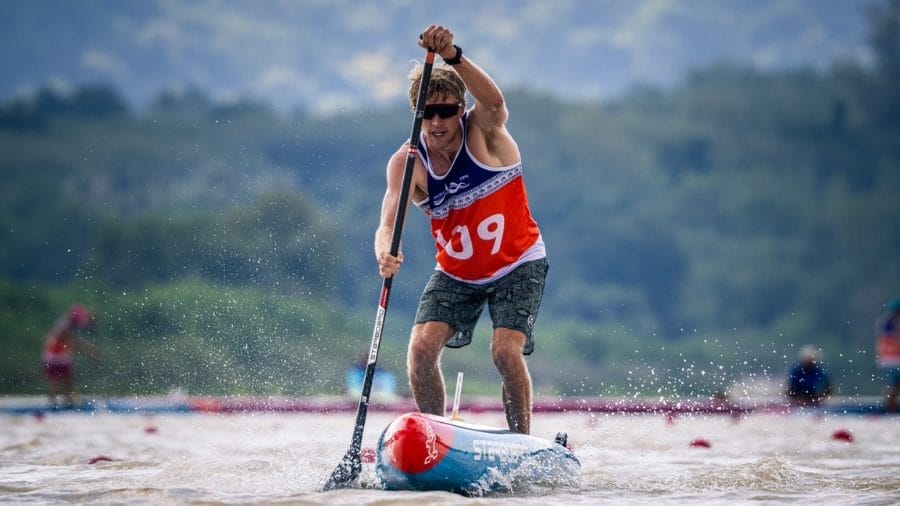
If there’s one SUP athlete to ask whether our sport has truly carved out its identity among other water and board sports, it’s Michael Booth – a name that carries both weight and integrity.
A multiple World SUP Champion, elite waterman, StarboardDream Team rider, coach, entrepreneur, and member of the ICF SUP Advisory Committee – he’s seen the sport from every angle, with a solid 360-degree view of where SUP has been and where it’s heading.
Through his coaching, Michael has helped develop grassroots paddlers into elite-level athletes – taking many of them into the top ranks while keeping the door wide open. No gatekeeping. Instead, he openly shares the mechanics of winning: his training methods, race strategies and even the hard-earned lessons when things don’t go to plan in major competitions.
His victory at the 2022 ICF World SUP Championships long-distance race in Gdynia, Poland – set against the unforgiving, brutally gnarly Baltic Sea that day – was one of the defining moments in my time covering the sport. I witnessed it firsthand and spoke to him just after he fell into an embrace with his father. It was raw, deeply moving and revealing – something real breaking through the surface of elite stand-up paddleboarding.
Moments like that make it clear: without dressing it up, Michael belongs in the GOAT (*Greatest Of All Times) conversation of our sport.
Now, in a true full-circle moment, we’re catching up ahead of his return to Europe – into a packed stretch of coaching camps and more racing on the horizon. Buckle up: this is a deep dive into performance, philosophy and the evolving culture of SUP.
Photo by Andy Klotz
Hi Michael, welcome back to TotalSUP and Europe! You’ve balanced being highly competitive with being deeply involved in growing the sport – what still keeps it fun for you?
Thank you for having me, I’m excited to come back and share this upcoming trip with my family!
I’ve been highly competitive for well over a decade now, and in the early years it was very much about learning, evolving, improving, and proving to myself and to the sport that I could do it and that I could win. That led to a lot of great results and a lot of travel to amazing places around the world.
Now, what keeps it fun is that my role in the sport has grown. I’m now on the ICF SUP Advisory Committee, which is something I’m enjoying as a new challenge, because it gives me a chance to help the sport grow in a sustainable way and contribute beyond just racing. I’m passionate about trying to help shape the sport in a way that works for more people, not just a select few.
I also really enjoy the coaching side. Coaching gives me a competitive edge in a different way, but it also gives a lot back. Helping athletes improve, solve problems, and get more out of themselves is something I genuinely enjoy. When you combine that with travelling, racing, coaching in different places, and meeting so many like-minded people around the world, it keeps the whole experience fresh and enjoyable. There are so many great people in paddling, and that community is a big part of why I still love it.
Photo courtesy of Michael Booth
As you head into a busy run of SUP training from Austria to Scotland – With clinics, shared knowledge & social media all playing a bigger role than ever, do you think it’s now easier for developing athletes to close the gap to the elite level – or is the goal of these clinics more about developing complete, well-rounded paddlers who stay healthy and injury-free?
I think it’s both easier and harder.
It’s easier now because there is so much more information available. Athletes can go on YouTube, Instagram, blogs, and all sorts of platforms and find a huge amount of content about SUP paddling. When I started, the sport was still relatively young and there just wasn’t that level of access. So in one sense, athletes now can learn a lot more, a lot faster.
But it’s also harder because there is so much information that it can become overwhelming. The challenge now is not just finding information, it’s finding the right information and figuring out what actually works for you as an individual. Otherwise people can get completely bogged down in noise.
That’s where coaches and clinics are really important. The value is in helping people cut through all that, work out what matters for them, and focus on what will actually move them forward. A big part of that is performance, of course, but it is also about helping people become more complete paddlers, move better, train smarter, stay healthier, and improve in a way that lasts.
Photo by Andy Klotz
Have you learned anything new yourself from coaching others?
Absolutely. I’ve learned a huge amount from coaching others.
One of the biggest things is that everyone learns differently. Just because one approach works for one athlete does not mean it will work for someone else. Coaching has really reinforced for me how important communication is, and how important it is to find the right way to explain something to each individual.
It has also taught me that performance is so much more than just training programs and physical preparation. That is obviously a big part of it, but the mental side is just as important. How athletes approach training, how disciplined they are, how consistent they are, how they handle nerves, and whether they can channel pressure into performance, all of that matters enormously.
Then there’s the technical side as well. Technique is never one-size-fits-all. It depends on the athlete, their body, their flexibility, their time on the water, and their overall experience. So coaching is this ongoing puzzle, and that’s one of the things I really enjoy about it.
Photo by Andy Klotz
What are the most common mistakes you see paddlers making, even at a high level?
Probably the biggest one is people following what everyone else is doing without stepping back and asking what actually works best for them.
You see paddlers trying to train or race in a way that suits someone else’s strengths rather than their own. For example, you might have a distance paddler trying to train like a pure sprinter, even though their body type, engine, and strengths are clearly better suited to something else. That happens a lot.
At a high level, I also think decision-making is one of the biggest separators. A lot of people don’t always think enough about the high-percentage play. They just follow the obvious move, go with the pack, or do what everyone else is doing, rather than racing to their own strengths and against other people’s weaknesses.
The best athletes are usually the ones making the smartest decisions under pressure. That’s where a lot of races are really won.
Photo by Andy Klotz
How would you describe the current energy in the SUP racing scene right now? What trends are you noticing? Are there areas – equipment, training or race formats – where you think we’ll see the biggest changes?
I think the sport is in an interesting place, and overall there are a lot of good things happening.
There has definitely been a shift in the landscape over the years, particularly from the US to Europe. COVID was a big turning point as well. Some of the bigger tours from the past don’t really exist anymore, and now we’ve got newer tours and events popping up, particularly across Europe, which has become a real centre of the sport.
At the same time, the sport itself has changed a lot. In the earlier days, there was much more emphasis on downwind, surf racing, and ocean-based events. Now there is a much stronger flatwater focus, with more racing on lakes and rivers, and generally shorter, more accessible formats. That has obviously helped participation in many places, especially in Europe, but I do think it is important that we keep some balance and don’t lose too much of that original ocean and long-distance side of the sport.
Personally, I’d like to see longer distance races continue to hold an important place. I think they should still be proper endurance events and not keep getting shorter and shorter, otherwise the sport starts to favour one type of athlete too heavily across everything.
In terms of equipment, I think it has reached a very high level now. Boards are highly refined and much more specialised to different conditions and race formats. Training has also become more specific, with a clearer split between pure sprinters and those racing technical and longer formats. So I think the sport is still evolving, but there is a lot of positive momentum there.
Do you feel the field has really deepened? We’re seeing juniors stepping up quickly and competing in the open division, while at the same time athletes in their 50s and 60s – are performing at a super high level. How do you think that’s shaping the sport right now?
Yes, I do think the field has deepened.
Originally, the sport felt much more top-end heavy. You had a relatively small number of elite athletes really driving it. Now I think there is a much better base underneath that, although it is stronger in some countries than others.
You can see that in junior participation, especially in places like Spain, Italy, and Greece, where younger athletes are coming through with a really high level. At the same time, it’s also great to see stronger age-group participation, including athletes in their 50s and 60s still competing at a very high level. I think that breadth across the age groups is really important.
It shows that the sport is maturing. We’ve now got more coaches, more experience in the system, and more people who have been around the sport for a longer period of time. That kind of growth across generations is very healthy for SUP, and I think the sport will only benefit from it.
Photo by Andy Klotz
What’s something you wish more people understood about the life of a professional SUP athlete?
I think people probably need to understand that the life of a professional SUP athlete has changed a lot over time.
When I first came into the sport, it was probably at the back end of what you could call a stronger professional era. There was more money around, more brand investment, and more of a push from bigger players, especially out of the US. These days, I think the sport has found a more natural level, which is not necessarily a bad thing, but it does mean it is harder for younger athletes to build a true professional career out of it.
The reality is there probably aren’t many fully professional SUP athletes in the pure sense. It’s more semi-professional or pro-am for most people. Athletes might get support with travel, entry fees, or equipment, but in most cases they still need to be doing a lot more around that. You need to be a high-level athlete, train consistently, manage your social media well, and often have other work alongside it to make it all possible.
For me personally, I’ve got a family, I’ve got work, I coach, and I still race. There are a lot of moving parts. But if you genuinely love the sport, you find a way to make it work and keep it enjoyable.
Photo by Andy Klotz
As a Starboard Dream Team rider to the core – have you ever felt the pull to try other gear / ‘new toys’ or do you see consistency as a real competitive edge?
I’ve been with Starboard for about 11 years now, and they have always been my competitive edge.
For me, consistency and trust are a real edge. I trust Starboard to produce great boards, great paddles, great fins, and to keep innovating. They’ve always been a premium brand, and they’ve been at the top of the sport for a very long time. That gives you a lot of confidence as an athlete.
Beyond that, I’ve always valued loyalty and alignment. Building long-term relationships with brands that match your values and ethics means a lot to me. I’m genuinely proud of the fact that I’ve had such long-term partnerships with a number of sponsors. Their trust in me, both in performance and in what I do more broadly, has played a big role in keeping me in the sport for so long.
So yes, new gear may be interesting, but in my view consistency over time will always beat chasing the next new thing for a short-term gain.
What’s been the biggest Starboard’s equipment breakthrough you’ve personally felt on the water?
There are probably two that really stand out to me.
One is the shift in paddle design, particularly the more current blade styles with the squarer bottom and cut-out in the blade. That has been something I’ve really liked and used for quite a while now.
The other, and probably the bigger breakthrough over time, was the move toward dugouts. That was a major shift in the sport. For a long time everyone was on flat decks, and then as dugouts developed, athletes were able to get lower to the water, narrow the boards more, and carry speed much better. That changed performance quite a lot.
That evolution also matched the way the sport itself was shifting. As racing moved away a bit from surf formats and more toward flatter and more controlled race environments, the equipment adapted as well.
Starboard has always been very strong at staying ahead of those trends, and the current All Star is as good a board as I’ve ever paddled. I feel very lucky to have been aligned with a brand that has continued to innovate at that level for so long.
How important is team culture in an individual sport like SUP racing?
I think team culture is incredibly important.
Even though SUP racing is an individual sport, no one really does it alone. I’ve been very fortunate to have long-term support from brands and sponsors like Starboard, Shaw and Partners, and Vaikobi, and those relationships become part of your journey. It really does feel like a bigger team or family around what you’re doing.
That support matters in practical ways, but it also matters in terms of identity and belonging. When I travel to events around the world, I know there is a network around me through Starboard, whether that is dealers, distributors, teammates, or people connected to the brand. That kind of culture and support makes a big difference.
You are still focused on your own performance, of course, but being part of something bigger and sharing a common identity with the people around you adds a lot. Team culture has definitely been a very important part of my career.
Do you feel SUP has its own culture or is it still finding its identity compared to other board sports like surfing or skateboarding? What needs to happen for it to truly stand on its own?
I think SUP absolutely has its own culture now, although there are also different cultures within it.
There is the flatwater racing community, the ocean racing community, the surfing side of SUP, the foiling side, and more general recreational paddling as well. A lot of that depends on where people live and what kind of water they have access to. If you live in a landlocked country, naturally your relationship with the sport is going to look different from someone who grew up on the beach and in the ocean.
But across all of that, there is still a shared identity. People love the water, they love being outdoors, and for a lot of people paddling is something that brings peace, clarity, and enjoyment. In that sense, SUP absolutely has its own culture and its own place now.
Of course, it still overlaps with paddling sports and surfing sports, so there will always be some crossover there. But I do think it stands on its own now. It has developed enough depth, variety, and community to have a real identity of its own.
Technical Improvement: Stroke efficiency, body position, and board trim
Conditions Handling: Managing side winds and maintaining momentum
Sessions provide direct, practical coaching to improve speed and confidence. For bookings and information, visit michael-booth.com.au or contact michael@michael-booth.com.au.
We’ve been following 19-year-old Unax Etxeberria through his coastal training sessions and drills, where his technique and ability to read the ocean look completely dialled in – making it all seem effortless. From Donostia in the Basque Country, the young racer has built a reputation for an explosive style, sharp control and an uncompromising approach […]
The launch of the all-new, lightweight Woven X Platin inflatable race board series marked the latest innovation from Light Board Corp – the team behind the PARADOXA race board, organisers of the SUP Alps Trophy, and the creators of one of the most hyped events, the Lake Rocks Festival. Known as the “Light Riders”, the […]
Starboard has done it again with the TallTwin, and when Zane Kekoa Schweitzer says “this thing rips,” the SUP surf world pays attention. Starboard‘s latest wave shape, the TallTwin, blends two seemingly opposite worlds: the speed, looseness and freedom of a Twinfin with the glide, trim and flow of a classic longboard. The result is […]
When Starboard announced Shuri Araki as the newest member of its Dream Team at the beginning of the year, the SUP world took notice. At just 20 years old, the Okinawan has already amassed eight senior World Championship titles – six ISA and two ICF – and remarkably, he has never raced in the junior division. […]
The countdown is on to the biggest edition of The Big Paddle Festival yet, as the popular Swiss event prepares to make history as an official stop of the European SUP League (ESL). Organised by Florian Gander – Founder of SUPkultur Wassersport Center and Co-founder of the Swiss Stand-Up Paddle Association – the festival will […]
Starboard‘s latest announcement has certainly caught the attention of the SUP community, as it goes far beyond a typical board launch. The project represents years of focused R&D, developed in collaboration with adventurer Bruce Kirkby. His vision was to bring wilderness SUP touring to a broader audience by creating a serious, all-round expedition platform – […]
Starboard has officially announced the latest addition to its elite Dream Team – one of the most highly anticipated pieces of news in the SUP racing world each season – and this year the spotlight falls on Brazil’s Guilherme Dos Reis. Fresh off claiming the Pan American SUP Championship title, Guilherme joins the Starboard Dream […]
Fresh off his appearance on LENNY BROS – the podcast hosted by Kai and Ridge Lenny – Connor Baxter opened up about the mindset behind dominating a sport for over a decade, while reflecting on the many transitions shaping this next chapter of his life: from a global SUP-erstar to fatherhood and becoming a Maui […]
As the SUP ALPS TROPHY / Paddelstadt Lake Rocks Festival returns to the stunning waters of Faaker See in Carinthia, Austria, get ready to watch all the action unfold LIVE from one of the most exciting weekends in stand up paddling. Taking place from 29 May – 1 June 2026, this iconic event is not […]